January 5th, 2026
Why Web Design Sales Pipeline doesn’t need to be hard
Most web designers rely on referrals because they are creative people, not salespeople, and without a Web Design Sales Pipeline in place their work arrives reactively instead of through a system. Their background is in design, structure, and delivery, not sales knowledge or sales experience. Referrals allow them to avoid building a Sales Pipeline altogether, because work arrives without having to understand prospecting, qualification, or follow-up.
The problem starts when referrals slow down or stop, when that happens, the business can stall, sometimes for good. Web designers then look for ways to generate leads, often turning to courses or generic sales advice. These rarely work because they are either outdated or built for a specific type of salesperson, not for creative professionals running a web design business.
Sales does not feel uncomfortable for most web designers, but it does feel foreign. Creative people tend to work best inside structure, while traditional sales approaches are often built around personality, confidence, and extroversion. This creates a mismatch between how designers naturally work and how sales is usually taught.
Without structure, sales feels chaotic. designers are used to clear processes when they build websites. When that same structure does not exist in Web Design Sales Pipeline, they feel lost as there is no clear next step, no routine, and no system telling them what to do when leads are quiet.
This lack of a Web Design Sales Pipeline creates real stress and uncertainty, bills still need to be paid, staff still need to be paid, and without consistent leads the business operates pay cheque to pay cheque. That pressure makes designers afraid to invest, afraid to plan, and stuck in a reactive cycle. The issue is not ability, it is the absence of their structured Web design Sales Pipeline.
A Sales Pipeline is simply a structured way to track how prospects move from first contact to becoming a client. Instead of relying on chance or referrals, a pipeline gives visibility, control, and predictability to the sales process. This is why having a clearly defined Sales Pipeline matters, especially for web designers who want consistent leads without relying on sales instinct or personality.
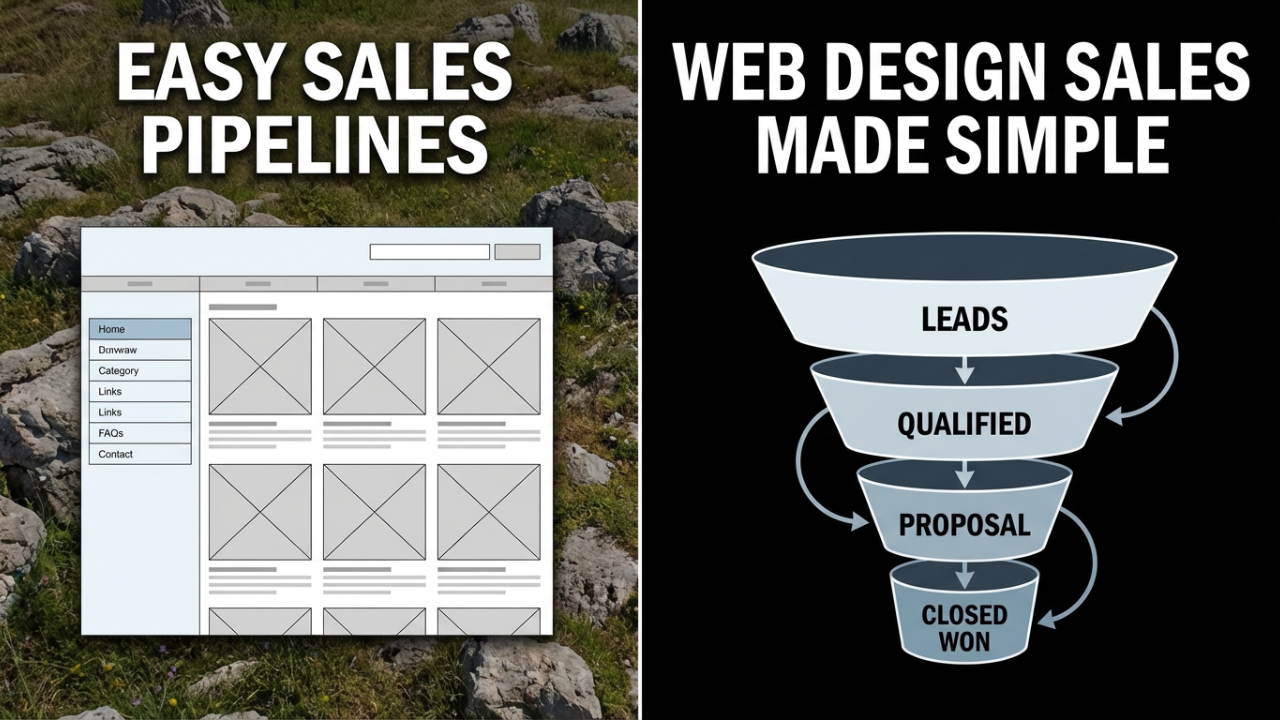
Why Great Web Design Doesn’t Create a Consistent Sales Pipeline
As I mentioned Web designers are creative people and do not naturally think like sales professionals. A good web design can and does generally lead to new clients, but it does not do so consistently on its own. The market has become highly competitive, with new platforms launching regularly that make it easier and cheaper for businesses to build websites. As a result, good design alone is no longer enough to keep leads flowing.
Portfolios can convert clients, but they cannot grow prospects, with the amount of competition in the market, clients now dictate the journey and often compare providers on price first. A strong portfolio helps once a prospect is already interested, but it does nothing to generate that interest in the first place. Web Design Sales Pipeline offer designers the prospect of controlling how prospects enter their business.
A common situation is that many web designers confuse the quality of their work with lead generation. Design quality is visual and only matters if someone sees it, however if no leads are being generated, there is no audience to show the work to. This creates a false belief that improving the portfolio will fix the problem, when the real issue is the lack of a structured in the pipeline.
Clients also rarely “just find” great designers consistently because the market is crowded. Even within a small geographic area, there are hundreds of agencies competing for attention. This is why a territory-based approach works, you do not need the entire market, a controlled 25-mile zone already contains enough opportunity when it is worked properly and consistently.
In our research, we identified an average of 65 digital marketing agencies operating within a single 25-mile radius. That number matters, as if you take Birmingham in the UK as a rough centre point and work outward in 25-mile zones, the scale of competition becomes clear very quickly.
From the centre of the UK to Bournemouth is roughly 160 miles, which equates to just over 6 zones. At 65 agencies per zone, that is over 400 competing agencies before you even reach the south coast. From Birmingham to the top of Scotland is roughly 550 miles, or 22 zones, which equates to around 1,400 agencies operating in the same broad market.
This is not even including businesses on the internet and in the US, so you can understand why clients no longer “find” great designers consistently. They are overwhelmed with choice, when hundreds of agencies look broadly similar, price becomes the deciding factor by default. A portfolio can help convert a prospect who is already interested, but it cannot compete at scale, and it cannot generate demand on its own.
This level of competition is also why improving your portfolio does not fix lead flow. Design quality is just visual, so if you are not generating leads, there is no one to show that quality to. The problem is not visibility, it is volume and control.
This is where a Web Design Sales Pipeline becomes essential. A properly built Web Design Sales Pipeline allows you to stop competing with the entire market. Instead of trying to win nationally or “be the best” you work within controlled territories. A few well-worked 25-mile zones already contain enough opportunity to build a stable business.
When done consistently, a web design Sales Pipeline does what great design cannot, it actually creates more leads and attracts a higher standard of prospect, without relying on chance or waiting to be discovered.
Why Sales Feels Hard When It’s Not Your Background
Web designers do not wake up thinking they are bad at sales, in fact many of them can pick up a phone, have a conversation, and communicate clearly. The issue here is not talking to people, the issue is strategic selling, which normally only comes from working in sales for years or fully understanding how the process works.
Sales becomes difficult when there is no experience behind it, it’s the knowing what to say, how to say it, where to find the right people, how to make those people easy to reach, and what to do once they show interest are not obvious skills. These are learned through repetition, structure, and exposure, not creativity.
For designers, it is not sales itself that causes friction, but the concepts behind it. Sales systems are usually built by salespeople for salespeople. Creative professionals do not naturally think in those terms, which makes applying traditional sales advice feel awkward and unnatural.
Selling also feels personal, because it is personal as in most cases, the designer is selling their own business, so rejection feels like rejection of their work, their ability, and their value. Without a process, every conversation carries emotional weight.
A structured Web Design Sales Pipeline removes this pressure, it provides regular leads, a clear process to follow, and a defined way to convert prospects into clients. Sales stops being about confidence or personality and becomes about following a system that works.
What Happens When Web Designers Have No Structured Sales Pipeline
The assumption is that once a website is delivered, the relationship will continue, in our research, where we qualified over 200+ businesses, it became clear this is rarely the case. Most businesses believe that once the website is live, the job is done, which then effects other marketing professionals in their own fields, this generally is the starting point where it goes wrong.
What happens next is silence, web designers let clients move on, even though there is more work that could be done. This happens because clients now dictate the journey. Around 90% of the time, the prospect controls the process, not the marketing professional. Designers are reluctant to challenge this because competition is high and they are afraid of losing the client altogether.
Without regular incoming leads, everything becomes reactive. Proposals, pricing, and follow-ups change from deal to deal because sales are not happening often enough to create confidence or consistency. Each enquiry feels important, so nothing is standardised.
Reacting to enquiries also kills long-term growth, so when designers respond instead of lead, they never control the narrative. There is no framework guiding the prospect from first contact to decision. Our Framework flips this by finding the prospect, nurturing them, converting them into clients, and then showing how to scale. No prior sales experience is needed, you follow the steps, the diaries, and the video walkthroughs until it becomes routine.
Discounting becomes common without a Web design sales pipeline, and it happens out of fear. Designers may deny it, but the pattern is clear across the industry, when the prospect controls the journey, price pressure follows. This is not limited to web designers, it affects most marketing professionals operating without a system.
The final risk is cash flow, without a structured Web Design Sales Pipeline, planning becomes impossible. There is no clear way to know what next month looks like, which halts growth and keeps the business stuck in uncertainty.
Why Random Leads Create Unstable Web Design Businesses
Random leads can work if you do not want to grow, and if you are working part-time or are comfortable staying small, relying on occasional enquiries is manageable. The moment you want to build a proper business, random leads are no longer enough. Growth requires consistency.
Quiet months change behaviour, so when leads slow down, fear sets in. Prices get lowered, decisions become rushed, and designers take on work they would normally avoid. These decisions are not strategic, they are driven by the need to survive.
Uncertainty also pushes designers into bad-fit projects, because when someone is willing to take anything, the foundations of the business become weak. Clients believe the website alone will solve their problems and that leads will follow automatically. When they do not, pressure shifts to later stages like SEO or marketing, which are then built on faulty foundations. Everyone is working in fear, and the business experiences spikes and lows instead of real growth.
A Web Design Sales Pipeline stabilises lead flow, but only if the process behind it is built properly. It is not just about having a pipeline, it is about following a repeatable process that creates that pipeline consistently.
Predictability matters more than volume. When you can see leads coming weeks and months ahead, you can plan, invest, and grow with confidence instead of reacting to whatever turns up next.
How Structure Replaces Sales Experience in a Web Design Sales Pipeline
Confidence does not create strategic selling, knowledge does. Without understanding how sales actually works, confidence only leads to inconsistent results. Structure matters more because it replaces the guesswork with a repeatable process that works regardless of personality.
When leads are slow, most web designers do not know what to do next, a framework removes that uncertainty. Instead of reacting, they follow a task diary system that tells them exactly what to do each day. They do not need to plan, research, or invent strategies. They turn up and complete the timed tasks.
The diary system is what creates consistency. Normally, marketing professionals would need to research market behaviour and build strategies themselves, however that work has already been done for them. The process is repeatable, so selling becomes routine rather than something that depends on motivation or mood.
This structure allows beginners and experienced professionals to perform at a similar level. Experienced marketing professional pick it up faster. Less experienced individuals follow step-by-step task instructions and video walkthroughs. Within around 31 days, the routine forms. Once the routine is in place and repeated, leads follow.
A Wen Design Sales Pipeline on its own does nothing, without a system behind it, it breaks down. The system is what turns sales into a routine instead of a skill. When people try to wing sales, organisation disappears and failure follows. With a structured framework, dedication and organisation are built in, which is why the system consistently outperforms improvisation.
The Next Step If You Want Consistent Leads
If you’re a web designer, you don’t need “sales confidence”. You need a system that tells you what to do when leads are not coming in, because when there is no structure, you get lost, you react., then you discount out of fear. You take bad-fit projects, then you end up building a business on unstable foundations, and growth becomes spikes and lows instead of predictable momentum.
That is exactly what our Framework fixes.
This is an operating system framework, delivered as a licensed platform that is cloned, branded, and made yours to run. We keep control because we support it, maintain it, and protect the integrity of the system. The goal is not to sell you information, the goal is simple to give marketing professionals a repeatable structure they can follow and actually win with.
Here is what that looks like in real use. You start with a setup routine that prepares you properly for day one. Setup is heavily explained and not timed, so you can take your time and understand the method. Then you enter the working days, each day is built as a full working day (up to 12 hours). You cannot skip forward, you cannot go back, you are locked into the day you are in, because this is designed to build routine, not motivation. Every single task is timed, and you get warnings as time runs down, you then complete the task, you move on, and your activity is logged.
Inside those days you are not guessing what to do, the tasks are step-by-step, supported with video walkthroughs, AI assistants, and saveable pages that record your inputs as you go. The system tells you how to find prospects, how to nurture them, and how to convert them into clients through a controlled process. And it doesn’t stop at “get a website client”. There is another diary system designed to grow the business and build on the right foundations, so you are not stacking marketing on top of broken systems.
Everything is measurable, dashboards show progress and analytics for solos and teams, so you can see what is being done daily, weekly, monthly, and yearly. Prospect activity is recorded too, so you can track whether your pipeline is being built properly. For teams, it is also territory-based and location-led, so different team members can operate different locations without overlap. On top of that, the Framework is built around niche entry points, so it can be adapted to the specific marketing professional niche, not forced into a generic sales model.
We do not guarantee “10 leads in 30 days” No serious system can promise that. What we can say is this was built from real live research, we built and lived inside a digital marketing business for six months, spoke to the market, networked, worked like them, and used that to refine the tasks until they match reality. If you already have a brand and attention, you will move faster. If you’re inexperienced, it will take longer. But the rule is the same, this only works when you do it every day. It is a repeatable process, and repetition is the point.
And if someone wants to dip in and out, they won’t get results. Honestly, they are not who we want in the Framework. That’s why access is controlled through our AI diagnostic. It determines whether you’re a fit to licence it, because this platform is built for marketing professionals who want structure and are prepared to follow it.
If you want to understand whether this fits you, don’t take my word for it. Go deeper. Explore the website, then watch the Framework walkthrough video where the whole system is shown properly. Once you’ve seen it, you’ll know if you want a structured operating system to build your Web Design Sales Pipeline, or if you want to keep relying on random leads and hope.
Watch the Framework Walkthrough
A guided walkthrough for marketing professionals evaluating structured growth.
Watch our Framework Walkthrough™
Already understand the framework?
Take the diagnostic to understand how your current foundations align with the AI–Human Agency Growth Framework™
View Framework LicensingWhy Good web design portfolios Fail to Create Growth